
REMIT researchers from Maastrict University have contributed data for our freshest dashboard, examining how the European Central Bank (ECB) has framed the Digital Euro in its official communications between 2018 and 2025.
Data author Siyuan Amber Qiao explains further:
“The Digital Euro is a proposed central bank digital currency (CBDC) issued by the ECB for use across the euro area. In 2018, ECB Executive Board member Benoît Cœuré suggested that a CBDC was unlikely to emerge within the next decade. A year later, Facebook’s announcement of its Libra project–a privately issued global stablecoin– changed the calculus overnight. The prospect of a large technology company issuing money at scale prompted central banks across the world, including the ECB, to accelerate their own thinking. From 2020 onward, the Digital Euro moved rapidly from a peripheral idea to an active institutional project. Over the following years, it evolved further from a technical discussion about payment infrastructure into a project bound up with questions of European sovereignty, strategic autonomy, and geopolitical resilience. This dashboard traces that shift through the ECB’s discourse on the Digital Euro.
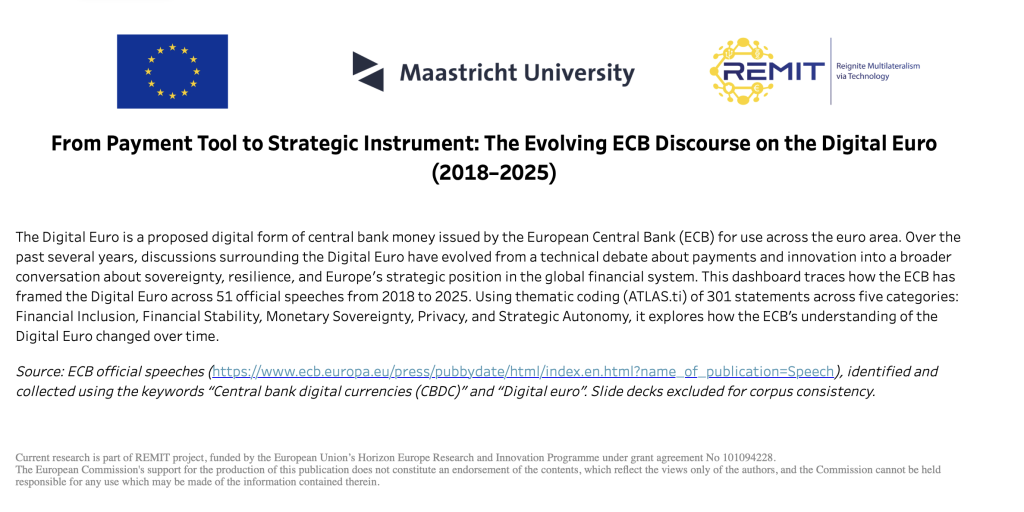
The dataset consists of 51 official ECB speeches, identified through keyword searches for “Central bank digital currencies (CBDCs)”and “Digital Euro” on the ECB’s public speech archive. Presentation slides were excluded to ensure corpus consistency, retaining only full-length speeches with argumentative depth. The 51 speeches were coded in ATLAS.ti, a qualitative data analysis tool, producing 301 coded statements distributed across five thematic categories: Financial Inclusion, Financial Stability, Monetary Sovereignty, Privacy, and Strategic Autonomy. These categories were derived inductively from the corpus and reflect the distinct policy frames through which ECB officials have approached the Digital Euro project.
The data reveal a clear pattern of discursive change. In the early years, particularly 2020 to 2022, ECB discourse was dominated by Financial Stability and Privacy concerns, reflecting the language of a central bank cautiously navigating a major technical and regulatory undertaking. Discussion surged in 2022, coinciding with the ECB’s formal investigation phase and the outbreak of the Russia-Ukraine war, which placed questions of European strategic autonomy firmly on the policy agenda. After a quieter 2023–2024 period, during which the project transitioned into its preparation phase and EU legislation remained pending, discourse peaked again in 2025, but with a fundamentally different character. Strategic Autonomy accounted for 42% of that year’s coded statements, with Monetary Sovereignty also rising sharply. The Digital Euro had been reframed: no longer primarily a payment innovation, but an instrument of European strategic positioning.
This research contributes to REMIT’s finance and technology focus area, specifically its work on how financial technologies intersect with questions of sovereignty, strategic competition, and European governance in the digital age. The Digital Euro, as this dashboard shows, is precisely such a case: a financial technology project that has gradually taken on the character of a geopolitical instrument.”