
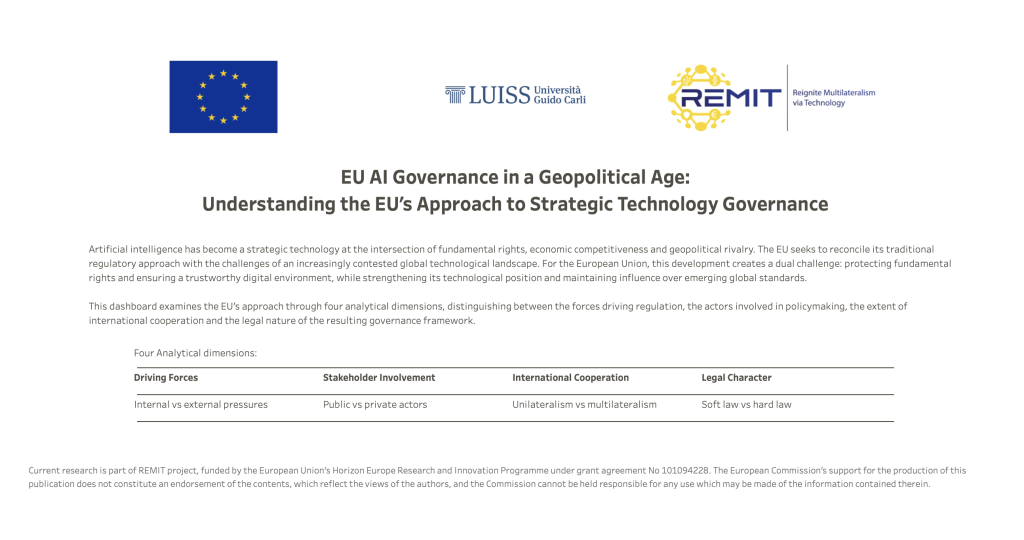
REMIT is very proud to announce our first dashboard by our Italian partners, Luiss Universitá di Roma! Based on an article by Thomas Christiansen, Flavia Lucenti and Maastricht’s Sophie Vanhoonacker (published soon in our Geopolitics Special Issue), the dashboard explores EU’s strategy in its AI governance.
The authors comment:
“Artificial intelligence (AI) is no longer simply a matter of technological innovation. As competition over emerging technologies intensifies, control over AI development and regulation has become an increasingly important source of economic and geopolitical influence. The United States, China and the European Union approach this challenge through different regulatory models, reflecting distinct political priorities, economic interests and understandings of the relationship between the state and the private sector. For the EU, this changing landscape presents a particular challenge. Traditionally committed to fundamental rights, market regulation and multilateral cooperation, the EU has increasingly recognised the strategic and security implications of technological governance. The adoption of the AI Act in 2024 represents a significant step in this direction, establishing the EU as a leading regulatory actor while raising questions about its capacity to remain technologically competitive and project its standards internationally.
This dashboard examines the EU’s approach to AI governance through four dimensions: the interplay between domestic priorities and external geopolitical pressures; the involvement and influence of public and private stakeholders; the degree of international cooperation; and the legal character of the emerging regulatory framework. The analysis highlights a central tension in the EU’s strategy. While the Union seeks to preserve its rights-based regulatory identity and promote international cooperation, it has largely relied on unilateral action to establish binding rules within its Single Market. Its ambition to shape global AI governance through regulatory diffusion and international standard-setting remains constrained by geopolitical rivalry, competing regulatory models and concerns about implementation and competitiveness.
Ultimately, the EU’s challenge is not only to regulate AI, but to ensure that its regulatory ambitions translate into meaningful influence in an increasingly contested technological order.”