REMIT’s latest dashboard is a contribution from our Nordic partner, the Finnish Institute of International Affairs (FIIA). The dashboard focuses on protection for critical undersea infrastructure with a particular focus on subsea data connectivity in Europe. The dashboard is focused on recent events in the Baltic Sea region which also present some important security lessons for critical maritime domains elsewhere in Europe.
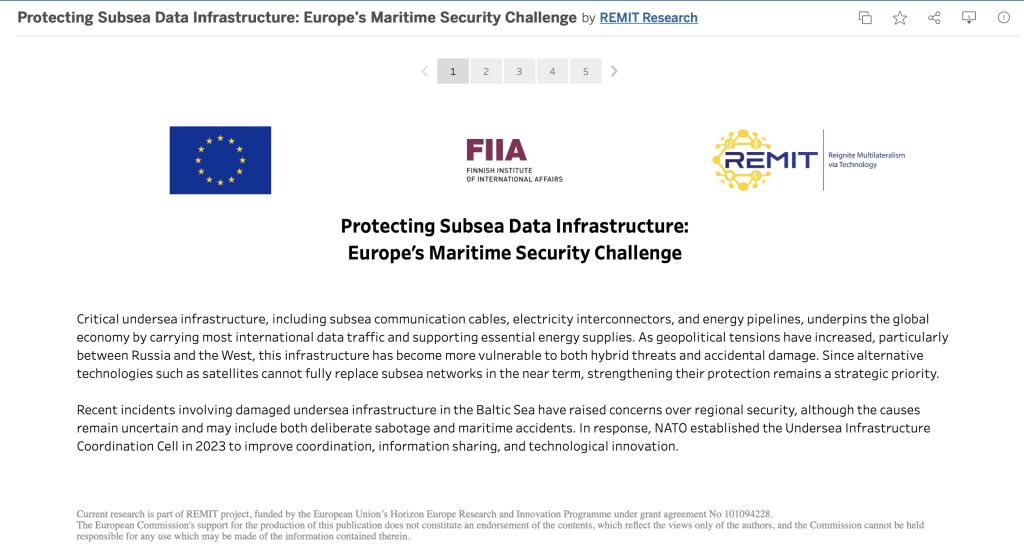
Undersea infrastructure is vital for the European and wider global economies when 95-99% of the world’s data is transmitted through a dense network of subsea cables. An estimated $10 trillion in financial transactions alone traverses these networks each day. As well as data cables, critical undersea infrastructure includes electricity connectors and pipelines supplying energy.
Development of undersea infrastructure is a focal priority in Nordic-Baltic regional integration. However, in a world where strategic competition is becoming more prevalent, vulnerable undersea infrastructure serving EU and NATO member states is at risk of becoming an attractive target for hybrid interference from revisionist powers seeking to compete with the West.
After Russia escalated its aggression in Ukraine in 2022, a series of high-profile incidents have occurred involving critical undersea infrastructure in the Baltic Sea. There are suspicions that this activity might be connected to a hybrid “shadow war” undertaken by Russia in response to developments including Nordic and Baltic support for Ukraine as well as Finland and Sweden joining NATO in 2023 and 2024 respectively. However, an uncertain picture on possible reasons is now emerging from authorities in Northern Europe on whether some recent incidents of undersea damage have been targeted or are, in fact, accidental.
Regardless of the motive behind some incidents, securing maritime domains remains vital for the EU and NATO. Ever closer cooperation between these two organizations is crucial for developing advanced technological solutions to protect maritime domains.
The dashboard highlights the importance of NATO’s Undersea Infrastructure Coordination Cell as a policy platform to enhance public-private partnerships innovating defence technologies supporting maritime security. Established in 2023, among the Undersea Infrastructure Coordination Cell’s earliest initiatives was its contribution to the NATO-European Union (EU) taskforce on resilience and critical infrastructure that reported recommendations for enhanced EU-NATO security cooperation in energy, transport, digital infrastructure and space policies.
The dashboard draws from an article by FIIA researcher Dr. Eoin McNamara entitled “Reinforcing resilience: NATO’s role in enhanced security for critical undersea infrastructure”, NATO Review, 28 August 2024. Dr. McNamara continues his research on this theme, among his latest outputs is a paper co-authored with Nele Loorents from the International Centre for Defence and Security (ICDS) in Estonia, entitled “Protecting critical undersea infrastructure: Enhancing NB8 maritime security cooperation”, The Nordic–Baltic Eight (NB8) Institute Series of Topical Briefs, No. 4, June 2026.