REMIT has published a new dashboard, based on the data of our UK partner, Virtual Routes. Titled “Tomorrow never dies: how “emerging technologies” shape cybersecurity futures”, the dashboard discusses the concept at large, and how it shapes the reality around it. Authors Apolline Rolland and James Shires explain more below.
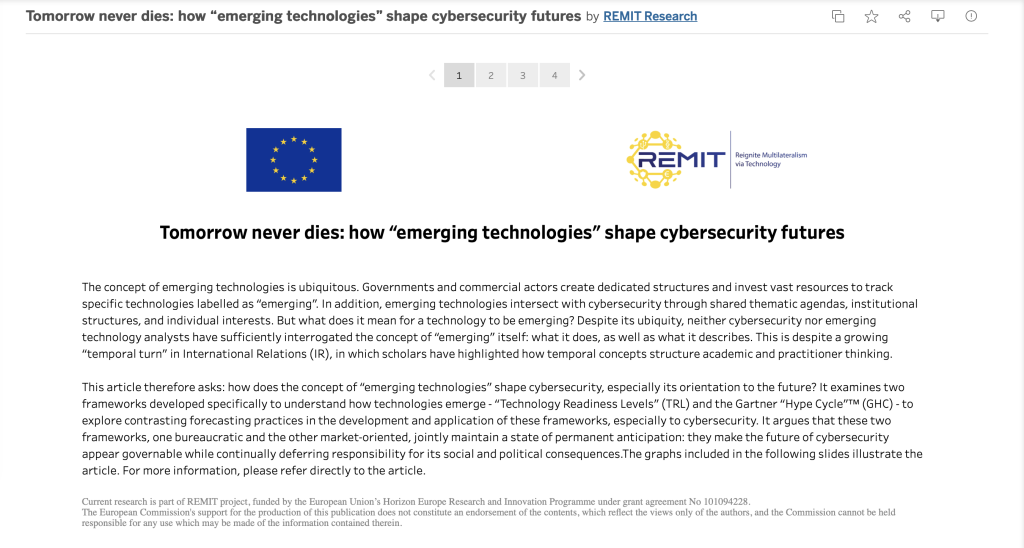
This dashboard is drawn from an original research article that will be published by Virtual Routes in Global Studies Quarterly on how the concept of ‘emerging technologies’ shapes cybersecurity and its future direction. Although the term ‘emerging’ is widely used by governments, industry, and international organisations, it is rarely examined critically. This work questions what this label means in practice: how it structures expectations, guides investment, and defines security priorities. Our research focuses on cybersecurity as a central case. The dashboard presents research highlights, and for more information, please refer directly to the article (out soon!).
First, the dashboard maps the historical evolution of technology assessment institutions, beginning with the US Office of Technology Assessment (OTA) in 1972. The OTA marked one of the first systematic efforts to ensure democratic control of emerging technologies by advising policymakers on their societal implications. Our research shows how similar institutions subsequently developed across Europe and other democracies aligned with the United States. This mapping also serves as an entry point and also shows how anticipatory technology governance has evolved over time, from a state-led approach to a market-oriented approach and then to a security-focused approach.
Our research identifies three key relationships between the concepts of emerging technologies and cybersecurity. First, emerging technologies are often seen as new sources of cyber risks. Second, they are perceived as reshaping the broader cybersecurity landscape, changing threat perceptions and governance debates. Third, cybersecurity itself is often described as an emerging technology, with its own trajectory of innovation and disruption. Distinguishing these relationships helps to clarify how different futures are imagined and prioritised.
The dashboard then presents two influential frameworks used to assess and anticipate technological development: Technology Readiness Levels (TRL) and Gartner’s Hype Cycle (GHC). TRL, rooted in state-led innovation systems, presents technological progress as linear and measurable, guiding decisions on public funding and procurement. The Hype Cycle, developed in a market context, reflects cycles of expectation and disappointment, influencing private investment and public discourse. Together, these tools give the impression that the technological future is controllable, while often overlooking deeper political and social questions concerning purpose, impact or responsibility.
By mapping how these frameworks are applied to cybersecurity, our research highlights patterns in how “emergence” is constructed and operationalised across policy and industry. It shows how classification tools influence which technologies receive attention and resources, and how responsibility for outcomes is distributed over time.
Within the EU-funded REMIT project, this work contributes to a broader effort to understand how emerging technologies interact with international security, governance and democratic oversight. Rather than taking “emerging” at face value, our research aims to reflect on how technological futures are framed, by whom, and with what consequences.