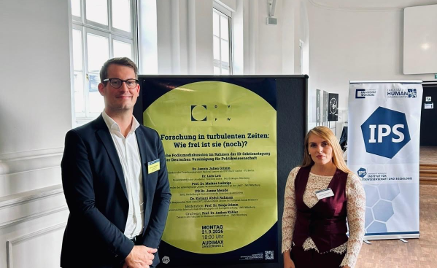
REMIT researchers Dr. Dennis Redeker and Dr. Chiara Spiniello, both from the University of Bremen, presented preliminary findings from ongoing REMIT research on public preferences for artificial intelligence governance at the Open Conference of the International Relations Section of the German Political Science Association (DVPW).
The conference took place at Julius Maximilian University of Würzburg from 21 to 23 September 2026, bringing together around 250 researchers from Germany and abroad for panels, roundtables and plenary discussions on current developments in international politics.
Redeker and Spiniello presented the paper “Contested Digital Empires: AI, Public Trust and Geopolitics in the Global South” as part of a panel on international political economy. The paper is co-authored with Fee Cohausz (GIGA/Heidelberg University), Ingmar Sturm (University of California, Santa Barbara), Imane El Qochairi (University of Bremen), and Adio Dinika (University of Bremen).
The study draws on a large-scale public opinion survey conducted within the REMIT project to investigate how people in countries across the Global South think about artificial intelligence and its governance. As data collection is still ongoing, the paper presented in Würzburg was based on preliminary results from eight countries.
The survey examines respondents’ values and concerns regarding artificial intelligence, their preferences for different approaches to AI governance, and their views on the roles that governments, markets and rights-based regulation should play in governing AI. By examining public attitudes rather than focusing exclusively on governments, regulators or technology companies, the research contributes to REMIT’s broader work on the relationship between public beliefs and normative diversity concerning emerging technologies, geopolitics and multilateral governance. It also seeks to provide a better understanding of how debates over competing models of AI governance are perceived outside Europe, the United States and China.