In September, REMIT researcher Siyuan (Amber) Qiao from Maastricht University participated in the 2026 European Consortium for Political Research’s (ECPR) General Conference in Kraków, Poland, where she presented research on the politics of central bank digital currencies (CBDCs) in China, the European Union (EU), and the United States (US).
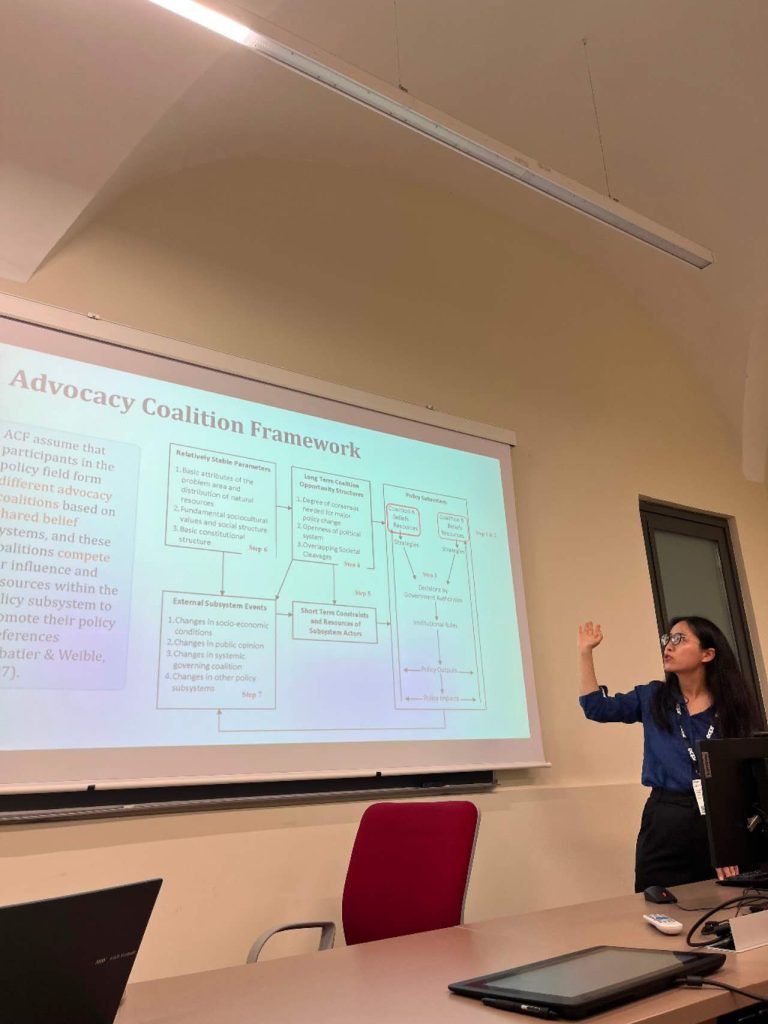
Amber presented the paper “Same Shock, Different Pathways: Coalition Opportunity Structures and CBDC Policy Change in China, the EU, and the United States,” co-authored with Professor Roberta N. Haar and Dr. Catherine Yuk-ping Lo, in the panel “Interaction of Actors, Ideas, and Institutions in the Advocacy Coalition Framework.” The paper examines why the emergence of Facebook’s Libra in 2019, despite creating a common external shock for policymakers across the three jurisdictions, contributed to very different CBDC policy trajectories.
Drawing on the Advocacy Coalition Framework, the study compares how institutional settings shape interactions among policy actors and opportunities for policy-oriented learning. It identifies three distinct pathways: learning and adaptation largely within the dominant policy coalition in China; greater interaction and learning across competing positions in the EU; and sustained political contestation in the US, where disagreement over CBDCs has increasingly intersected with wider debates over stablecoins and the role of private digital money.
The comparative paper presented in Kraków builds on earlier work on the China and EU cases. In July, Amber presented research on the evolution of China’s digital yuan (e-CNY), co-authored with Dr. Catherine Yuk-ping Lo, at the ECPR’s 13th Biennial Conference of the Standing Group on the European Union (SGEU) at the University of Catania. The EU case draws on Amber’s research on the digital euro, which examines advocacy coalitions and policy learning in the EU policy process and will appear as a chapter in REMIT’s forthcoming edited volume, Navigating the Geopolitics of Strategic Technology. Together, these studies form part of REMIT’s ongoing research into the changing governance of digital money and the wider transformation of international monetary and financial governance.