
To wrap up 2025, we present a brand new REMIT dashboard, created with the contributions from our Romanian partners, Babeș-Bolyai University. Below, authors Oana Poiana and Raluca Moldovan go in-depth about their work, and what it means contextually.
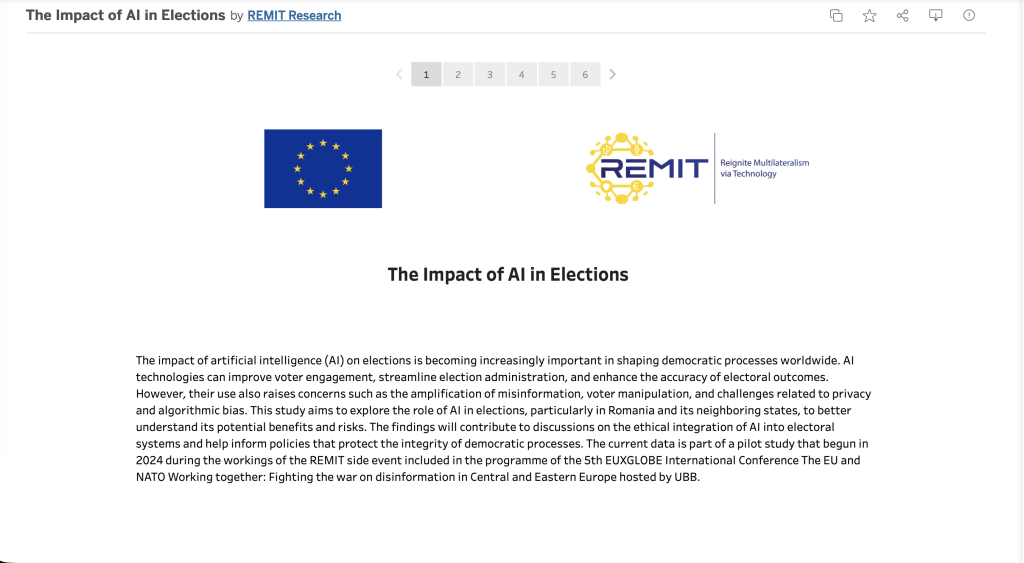
Artificial intelligence (AI) is increasingly shaping electoral processes worldwide, influencing how political information is produced, circulated, and consumed, as well as how electoral campaigns are organised and elections are administered. From automated content generation and data-driven political communication to tools supporting electoral management, AI technologies are becoming embedded across multiple stages of the electoral cycle. At the same time, their growing use raises significant concerns, including the amplification of disinformation, risks of voter manipulation, challenges to data protection and privacy, and the potential reinforcement of algorithmic bias. These dynamics have prompted renewed debates about democratic resilience, electoral integrity, and the adequacy of existing governance frameworks.
This dashboard explores the role of AI in elections with a particular focus on Romania and its neighbouring states, situating national-level developments within a broader regional context. Drawing on data collected as part of a REMIT pilot study, it provides an empirical overview of how AI-related phenomena are identified, discussed, and observed in electoral settings. The visualisations are designed to highlight patterns, differences, and emerging trends, offering insights into both the potential opportunities associated with technological innovation and the risks these technologies may pose to democratic processes.
The data presented here originate from a pilot research exercise conducted in 2024, developed during the REMIT side event at the 5th EUXGLOB International Conference – “The EU and NATO Working Together: Fighting the War on Disinformation in Central and Eastern Europe”, hosted by Babeș-Bolyai University (UBB). As an exploratory analytical tool, the dashboard does not seek to provide definitive assessments or causal claims. Instead, it aims to support ongoing research, comparative analysis, and policy-oriented reflection on the evolving intersection between artificial intelligence, elections, and democratic governance. The study is based on responses collected through a structured questionnaire focusing on perceptions of artificial intelligence and its role in electoral processes, with a particular emphasis on Romania and neighbouring states. Given its pilot character, the dataset is exploratory and not intended to be statistically representative. The results reflect respondents’ self-reported awareness, evaluations, and concerns, and should be interpreted as indicative of emerging patterns and themes rather than as definitive empirical assessments. The dashboard visualisations are designed to support comparative interpretation and policy-oriented reflection, contributing to ongoing research on the governance of emerging technologies and their implications for democratic processes.
Overall, the findings presented in this dashboard suggest that awareness of artificial intelligence in electoral processes is emerging but uneven across Romania and neighbouring states, accompanied by mixed assessments of how effectively such technologies are currently utilised. While respondents recognise the potential of AI to support electoral processes, ethical concerns—particularly related to misinformation, transparency, privacy, and accountability—feature prominently in their evaluations. At the same time, there is a clear expectation that stronger governance frameworks, regulatory safeguards, and oversight mechanisms are necessary to ensure responsible use. Taken together, these insights highlight the importance of aligning technological innovation with democratic norms and multilateral cooperation, reinforcing REMIT’s broader objective of understanding how emerging technologies can both challenge and support democratic governance in a rapidly evolving international environment.